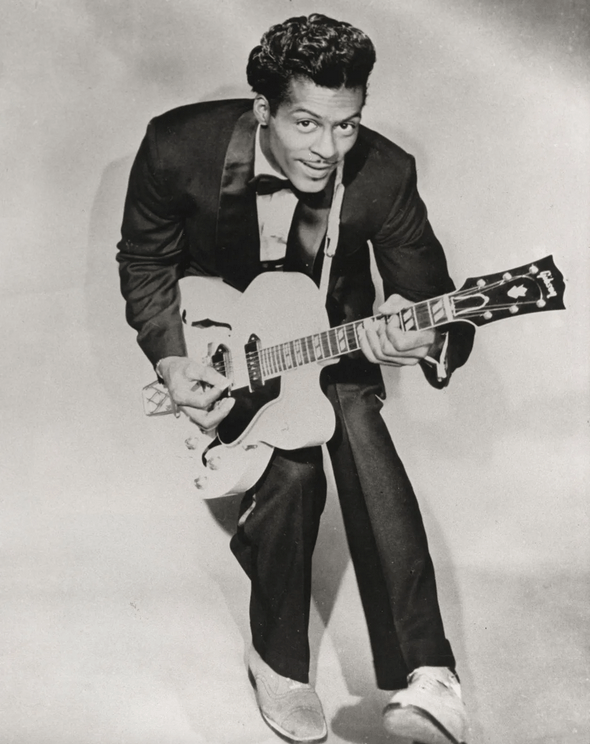
70 years on and Chuck Berry’s breakthrough record is still as much a gold standard in the art of record production as it ever was.
Despite the technology having progressed and the number of genres (& records) to draw upon having grown exponentially, the ‘rules of the game’ that records like ‘Maybelline’ (1955) adhered to are still informing the best popular music productions in 2024. But it didn’t occur in a vacuum.
Background: The birth of Electric Blues & Chess records
In 1950, Chicago brothers Leonard and Phil Chess – Jewish immigrants from Poland – had a minor hit with the first release – Muddy Waters’ ‘Rolling Stone’ – on their nascent blues label. Selling 70,000 copies, this early success emboldened both the brothers and Waters to carry on with their fruitful collaboration. Waters even quit his day job.
While ‘Rolling Stone’ featured Waters alone on vocals and electric guitar, the artist convinced Chess that subsequent releases should feature his live band. Add to this mixture the songwriting prowess of bassist Willie Dixon and local hit after hit ensued. This small combo, including Little Walter on amplified harmonica, enamoured the format with both local audiences and groups that followed. It also later influenced the de rigueur 1960s rock band format of drums, bass, electric guitars and vocals.
A Savvy Salesman: Rock n roll & Cross-over potential
Having experienced racial prejudice themselves, the Chess brothers had empathy for the Black Chicago blues musicians they recorded and similarly understood how to market their material. Leonard, in particular, was acutely sensitive to local audience’s tastes, moods and which records they might best respond to. Importantly, he noticed how the visceral nature of certain productions made people want to dance more than others.
Despite having tapped into a sizeable Black audience for Electric Blues in Chicago and much of the rural South, chess was well aware that in order to make any real money airplay by white radio stations was needed.
By 1955, early Rock n Roll records by white artists such as Bill Haley and his Comets and Elvis Presley fused Hillbilly music with Rhythm & Blues, thus whetting young white kids’ musical appetite for Black music. So, when Muddy Waters encouraged A 29-year old Chuck Berry to pitch some of his original tunes to Chess, the cross-over potential for his song ‘Ida Mae’ – a variation on the Western-Swing track ‘Ida Red’ by Bob Wills and his Texas Playboys (1938) – was not lost.
Chess urged Berry to rename and revamp the number for young white audiences, with their ever-growing obsession with cars, speed and lost love.
“As I was motor-vatin’ over the hill”
It’s what Berry does lyrically with the material that makes ‘Maybellene’ so much more than a cynical cash-in. His genius was to understand that the cultural conduit of Rock n Roll could flow both ways, and he was able to find some common ground between his own life struggles and the frustrations of white teens as a cultural sub-group.
Much has been written about Berry’s masterful lyric writing, his gift for narrative, wordplay, alliterations, phrasing, and not least, an empathy for the minutiae of the world of post-war teenagers. It is with ‘Maybellene’ however, that HE first found a vehicle (pardon the pun) for his particular type of ‘code switching’ and vocal delivery equal parts Muddy Waters’ power & Nat King Cole’s finesse/articulation. Berry’s musical and lyrical innovations would resound well beyond Chicago and the South: even internationally (Think The Rolling STones and Beatles).
It is equally the sound of ‘Maybellene’ that places it firmly within the burgeoning Rock n Roll movement. with its clear backbeat (emphasis on 2 and 4 beats) and prominent Elvis-style vocal tape echo, the record was perfectly placed to make Berry an American Bandstand favourite. The growl of Berry’s distorted electric guitar on the track (echoing Muddy Waters’ tone) was yet another major contribution to the genre. And then the was the rapid-fire note bending.
Like it or not, popular music today is still playing the same game it was back in 1955: acting as a conduit between the sounds of the street and consumers everywhere. When empathy outweighs cynicism however – as is the case on this particular record – there is hope for transcendence.


Click to play
 Dr Marshall Heiser